The Future Beyond BizTalk 2020: Migration Paths, Cloud Opportunities, and Staying Put
Introduction
Microsoft BizTalk Server has been a backbone for enterprise integration scenarios for more than two decades, enabling businesses to connect systems, orchestrate workflows, and manage complex data exchanges. The latest version, BizTalk Server 2020, is still supported today — but the clock is ticking. By 2030, BizTalk will move into extended support only, marking the end of mainstream innovation and updates.
For organizations still running BizTalk, now is the time to start thinking about the mid-term migration strategy. Whether you operate primarily on-premises, in the cloud, or somewhere in between, there are multiple paths forward — each with unique considerations.
1. Staying On-Premises: Modernizing Locally
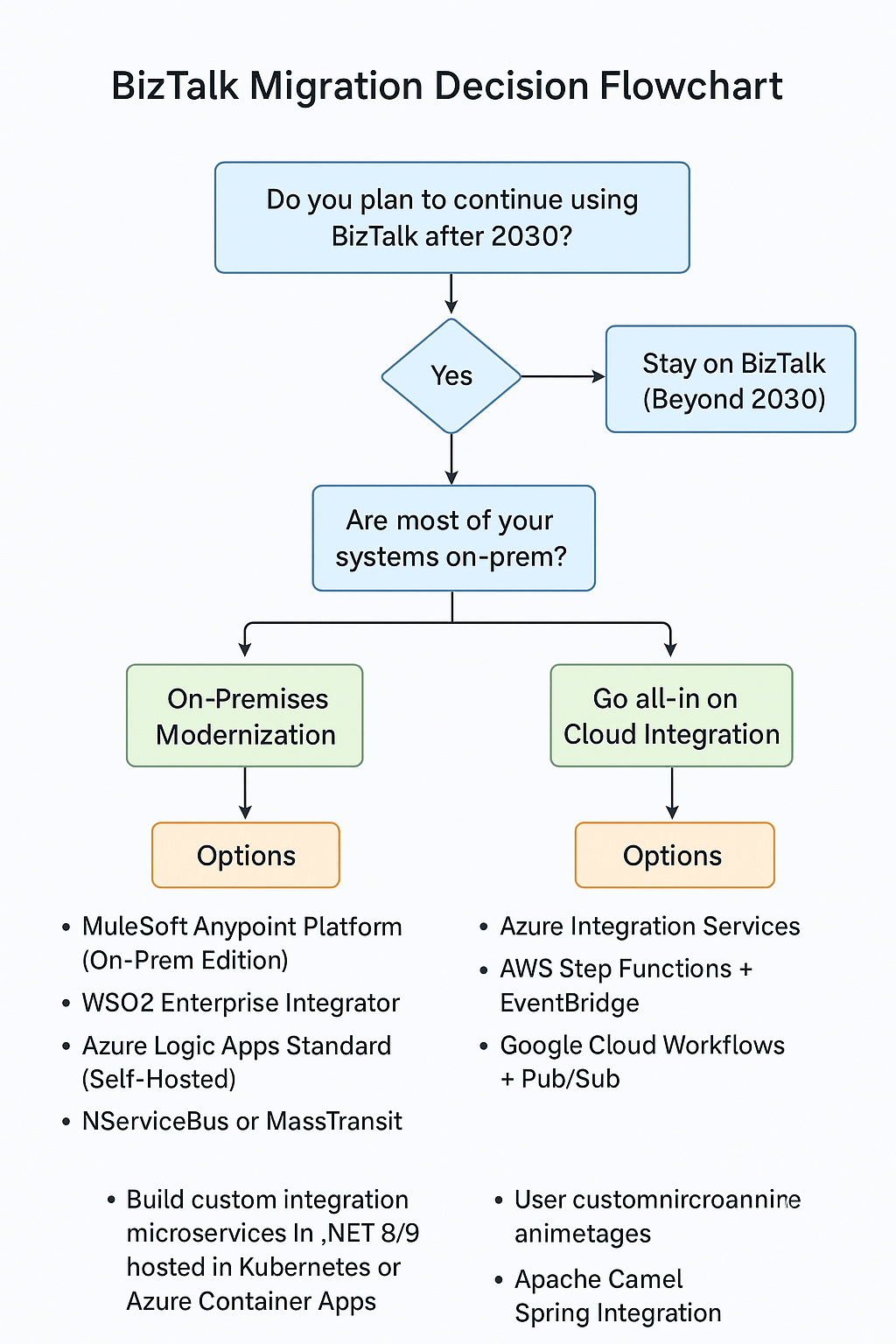
For companies whose systems remain largely on-premises, the most straightforward option might be to replace BizTalk with another local integration platform.
Key migration options:
- MuleSoft Anypoint Platform (On-Prem Edition) – Comprehensive integration features, strong enterprise tooling, and can run entirely in local data centers.
- WSO2 Enterprise Integrator – Open-source, Java-based integration stack with a modular architecture.
- Azure Logic Apps Standard (Self-Hosted) – Microsoft’s modern integration tool, now with a self-hosted runtime that can operate fully on-prem.
- NServiceBus or MassTransit – If integration needs are messaging-heavy, these .NET-based service bus frameworks offer fine-grained control.
Pros:
- No dependency on cloud infrastructure.
- Direct control over compliance, latency, and data security.
- Can reuse .NET development skills, easing the learning curve.
Cons:
- Potentially higher maintenance burden.
- Limited access to modern cloud-only services and AI-driven integration.
2. Going All-In on Cloud Integration
If most of your systems are already in the cloud, the natural move is toward cloud-native integration platforms.
Leading options:
- Azure Integration Services – Microsoft’s recommended successor, combining Logic Apps, Service Bus, Event Grid, and API Management into a fully managed integration suite.
- AWS Step Functions + EventBridge – If your primary cloud is AWS, these services can replace many BizTalk orchestration scenarios.
- Google Cloud Workflows + Pub/Sub – Event-driven integrations for GCP-based environments.
Pros:
- High scalability and availability.
- Integration with other cloud-native services (e.g., AI, analytics, serverless).
- No infrastructure maintenance.
Cons:
- Ongoing operational costs.
- Vendor lock-in risk.
- Potential challenges integrating with remaining on-prem systems.
3. Leveraging In-House Development Skills
BizTalk customers typically have strong .NET developer teams — and sometimes Java expertise as well. This can open doors to custom-built integration solutions that leverage in-house skills.
If you have .NET expertise:
- Build custom integration microservices in .NET 8/9, hosted in Kubernetes or Azure Container Apps.
- Use Dapr (Distributed Application Runtime) to simplify messaging, pub/sub, and service invocation.
If you have Java expertise:
- Apache Camel – Highly flexible integration framework with a large library of connectors.
- Spring Integration – Well-suited for building enterprise integration patterns in Java.
Pros:
- Maximum flexibility.
- Tailored exactly to business needs.
- Reuse existing developer skillsets.
Cons:
- Higher initial build cost.
- Long-term maintenance responsibility.
4. Continuing with BizTalk Beyond End-of-Life
Some organizations may choose to keep BizTalk running even after extended support starts in 2030.
Potential benefits:
- Avoids large migration project costs in the short term.
- Minimal disruption to business processes.
- Existing integrations and monitoring remain unchanged.
Risks and pitfalls:
- No new features or connectors – growing incompatibility with newer systems.
- Security vulnerabilities – no security fixes after extended support ends.
- Skill attrition – fewer developers with BizTalk experience over time.
- Hardware/OS compatibility issues – future Windows Server versions may not support BizTalk.
This approach can work as a short-term risk acceptance strategy but is not sustainable indefinitely.
Option Comparison Table
| Option | Ideal For | Pros | Cons |
|---|---|---|---|
| On-Premises Modernization | Mostly local systems | Control, security, reuse .NET skills | Maintenance burden, limited cloud integration |
| Cloud Migration | Mostly cloud systems | Scalability, innovation, managed services | Ongoing costs, vendor lock-in |
| Custom In-House Solution | Strong dev teams (.NET or Java) | Full flexibility, tailored to needs | Higher build/maintenance effort |
| Stay on BizTalk Post-2030 | Delay migration | No disruption, low immediate cost | Security risks, obsolescence |
Final Thoughts
The end of mainstream support for BizTalk Server 2020 in 2030 is not an immediate crisis — but it is a clear strategic inflection point. Businesses that start planning now can choose the migration path that best fits their system architecture, compliance needs, and internal skillsets.
- If you’re mostly on-prem, explore modern local integration stacks or self-hosted Logic Apps.
- If you’re cloud-first, consider Azure Integration Services or equivalent cloud-native tools.
- If you have strong internal dev talent, a custom-built integration layer can be future-proof and highly adaptable.
- If you stay on BizTalk beyond 2030, treat it as a temporary measure with clear risk mitigation.
The sooner you start the assessment, the smoother the transition — and the more value you can extract from your next-generation integration platform.
Here’s a nice flowchart describing the options:
Leveraging the ESB Toolkit in BizTalk Server 2020: A Practical Integration Scenario