From BizTalk Server to Azure-Native Integration: Reimagining Enterprise Workflows
Introduction
For over two decades, BizTalk Server has been the workhorse of enterprise integration—powering mission-critical workflows, EDI exchanges, and B2B integrations. With the release of BizTalk Server 2020, Microsoft provided a modernized, cloud-friendly version, but the shift toward cloud-native architectures has opened a new chapter in integration strategy.
Today, organizations are increasingly complementing—or replacing—BizTalk with Azure-native services such as Logic Apps, Azure Functions, Durable Functions, and Azure Integration Services.
This post explores how typical BizTalk solutions can be reimagined in the Azure ecosystem, the strengths of each approach, and the trade-offs to consider.
1. Why Organizations Are Rethinking BizTalk
BizTalk remains reliable, battle-tested, and enterprise-grade, but:
- Hosting and maintenance overhead – Requires Windows Server, SQL Server, and patching.
- Scaling challenges – Scaling BizTalk means scaling the whole environment, not just a component.
- Modern integration needs – Microservices, serverless, and event-driven architectures often demand faster, more granular deployment models.
The Azure integration stack offers:
- Consumption-based pricing
- Horizontal scalability
- Faster iteration and deployment
- Built-in connectivity to SaaS and cloud services
2. Typical BizTalk Patterns and Azure Counterparts
| BizTalk Pattern | Azure-Native Equivalent | Strengths in Azure | Potential Trade-offs |
|---|---|---|---|
| Receive/Send Ports for data ingestion and delivery | Logic Apps connectors + Service Bus | 400+ connectors, easy SaaS integration, managed connectivity | May require hybrid connectors for on-premises access |
| Orchestrations for complex workflows | Durable Functions or Logic Apps (Stateful) | Serverless orchestration, code-first or designer-first options | Debugging can be more complex in distributed environments |
| Message Transformation (Maps) | Liquid templates in Logic Apps, Azure Functions with custom code | Flexible, polyglot transformations, no BizTalk map tool dependency | Lacks native visual mapping like BizTalk Mapper |
| Business Rules Engine | Azure Functions or Power Automate | Cloud-hosted logic, easily updated | No direct BRE equivalent—rules must be reimplemented |
| Adapters (FTP, SAP, MQ, etc.) | Logic Apps enterprise connectors, Integration Account | Prebuilt enterprise adapters, pay-per-use | Some adapters require ISE or Premium tier |
| BAM Tracking | Azure Monitor, Application Insights, Log Analytics | Unified observability for all services | Different tooling and dashboards vs. BAM portal |
3. Example: Reimagining a BizTalk Orchestration in Azure
Scenario:
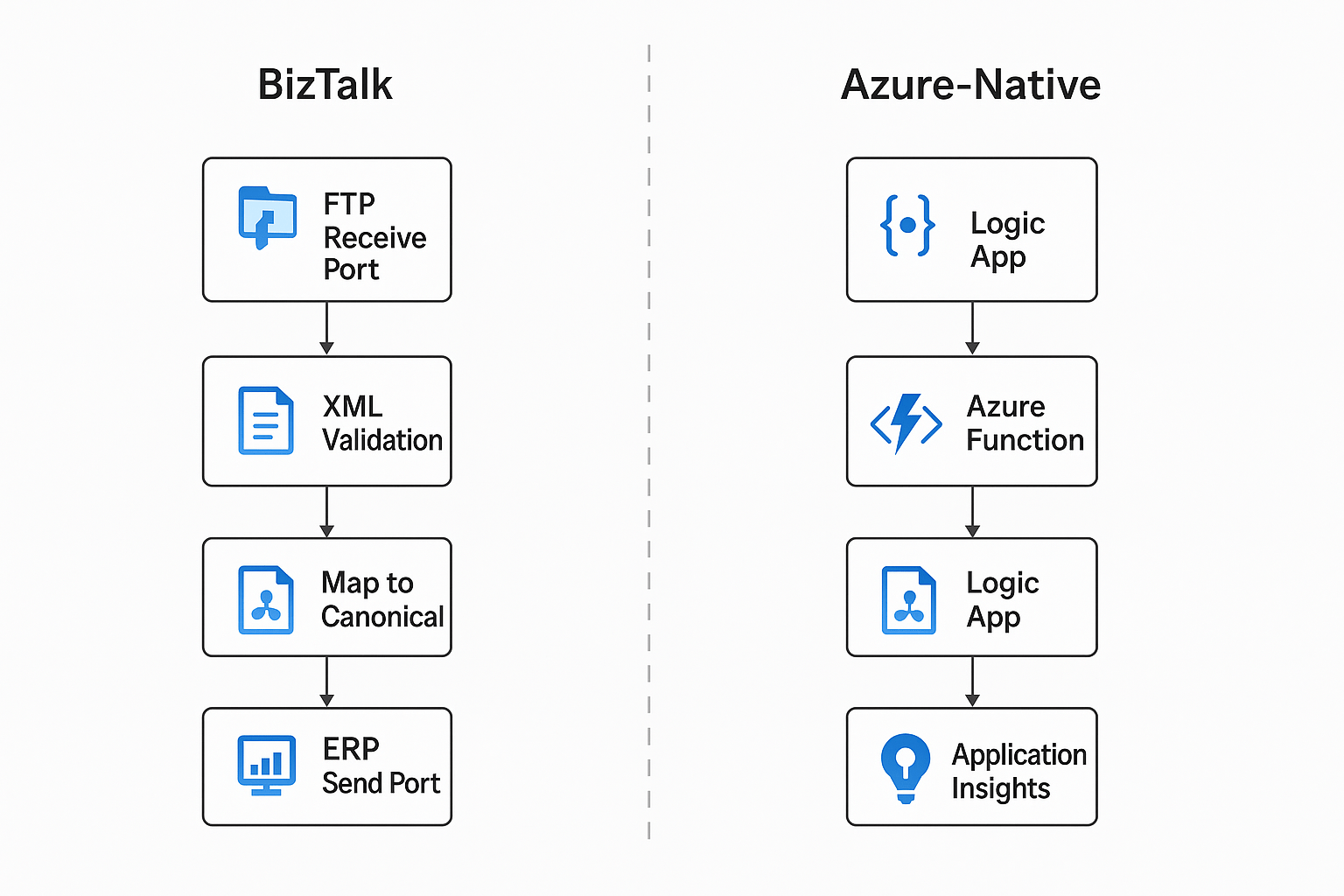
A BizTalk orchestration processes incoming orders from FTP, validates them, transforms them into a canonical format, and sends them to an ERP system.
BizTalk Flow:
- FTP Receive Port → XML Validation → Map to Canonical → ERP Send Port
Azure-Native Flow:
- Logic App (FTP connector) to receive files
- Azure Function to validate and transform the payload (or Liquid in Logic Apps)
- Logic App (ERP connector) to send data to ERP
- Application Insights for logging and metrics
Advantages:
- No server maintenance
- Pay only when triggered
- Independent scaling for ingestion and processing
4. Strengths of the Azure Approach
- Elasticity – Scale individual steps independently.
- Pay-per-use – Cost savings for infrequent workloads.
- Faster innovation – Deploy small updates without touching the whole integration stack.
- Rich ecosystem – Seamless SaaS connectivity and hybrid integration with on-premises systems.
5. Trade-offs and Considerations
- Latency – BizTalk can process messages in-memory within its host; Azure services may have higher latency for chatty workflows.
- Hybrid complexity – On-premises data access requires secure hybrid connections (e.g., Azure Hybrid Connection, VPN, ExpressRoute).
- State management – Durable Functions handle state well, but long-running workflows require careful timeout and cost planning.
- Skill shift – Moving from BizTalk’s visual tooling to Azure Functions or Liquid mapping may require developer upskilling.
6. Migration Strategies
- Coexistence – Start by offloading new workloads to Azure while keeping BizTalk for legacy integrations.
- Phased migration – Gradually reimplement BizTalk applications as Azure-native equivalents.
- Greenfield approach – For new projects, go cloud-native from the start.
7. The Road Ahead
BizTalk Server 2020 will be supported into the next decade, but the integration world is firmly moving toward serverless, event-driven, and composable architectures.
By reimagining BizTalk patterns with Azure-native services, enterprises can position themselves for:
- Greater agility
- Lower operational overhead
- Closer alignment with modern development practices
Bottom line:
BizTalk’s strengths are undeniable—but in a cloud-first world, Logic Apps, Azure Functions, Durable Functions, and Azure Integration Services offer flexibility, scalability, and cost models that fit today’s integration needs. The smartest path forward is often hybrid now, cloud-native over time.
Here is a diagram that depicts this graphically: